Research Article - (2022) Volume 20, Issue 3
Comparative Analysis of Ultrasound-Guided Transmuscular Quadratus Lumborum Block Versus Transversus Abdominis Plane Block for Postoperative Analgesia After Lower Segment Cesarean Section at a Tertiary Care Academic Medical Center: A Retrospective Cohort Study
Ibrahim Shazly Mohamed, Amr Raafat Mahmoud Seif*, Amr Raafat Mahmoud Seif, Jumana Baaj and Ahmed Alizein ElnizamyReceived: 30-Jun-2022, Manuscript No. gpmp-22-194582; Editor assigned: 19-Jul-2022, Pre QC No. P-194582; Reviewed: 03-Aug-2022, QC No. Q-194582; Revised: 17-Aug-2022, Manuscript No. R-194582; Published: 24-Aug-2022
Abstract
Objective. The aim of our study was to evaluate a range of heart rates in the first trimester in twin pregnancy and the influence of the rate of fetal heart on the outcome of the pregnancy. Background and
Objectives: Managing acute post-cesarean pain remains challenging. This retrospective study aimed to compare the analgesic duration, 24-hour analgesic consumption, and postoperative pain trajectories of ultrasound-guided bilateral transmuscular Quadratus Lumborum (QL) blocks versus Transversus Abdominis Plane (TAP) blocks within an institutional multimodal analgesia protocol.
Material and methods. The study included 89 twin pregnan cies between 6 and 11 weeks of pregnancy (78 pregnancies finished with good outcome and 11 with unfavorable outco me). Materials and Methods: This retrospective cohort study was conducted at King Saud University Medical City, Saudi Arabia, over a 1-year period (January 1 to December 31, 2023). Eighty adult parturients undergoing elective lower segment cesarean section under spinal anesthesia were analyzed (n = 40 in the QL block group; n = 40 in the TAP block group). Both cohorts received bilateral fascial plane blocks utilizing 15–20 mL of 0.25% bupivacaine per side. Results. The date shows that the heart rate of embryos / fetuses in the first trimester of an uncomplicated twin pregnancy progressively increases between 6 and 8 weeks of pregnancy and then slows down in week 11. Our data shows that the rate of fetal death in the first trimester of twin pregnancy increases progressively with decreasing of the heart rate. In our study none of the twins survived when the observed rate of the fetal heart was less than 110 beats per minute and half of them died when heart rate was between 110 and 120 beats per min. Furthermore, the significant difference in the heart rates of a set of twins was connected with a poor prognosis. In mono chorionic pregnancies with a significant difference in heart rate (20 beats/min or more) despite a normal fetal heart rate (120 beats/min or more) TTTS syndrome was confirmed later in pregnancy.
Results: The primary outcome, mean time to first rescue analgesia, was significantly prolonged in the QL cohort compared to the TAP cohort (21.49 ± 2.05 hours vs. 13.01 ± 1.43 hours; p < 0.001). Total 24-hour paracetamol consumption was significantly lower in the QL group (4.36 ± 0.54 g) than the TAP group (9.98 ± 0.82 g; p < 0.001). Dynamic pain scores (VAS) during functional movement were significantly lower in the QL group across all postoperative intervals from 2 to 48 hours (p < 0.001). Complication rates and hemodynamic profiles were statistically indistinguishable between groups (p > 0.05). Conclusion: The ultrasound-guided trans muscular QL block offers significantly longer analgesic duration, superior control of dynamic movement pain, and lower 24-hour non-opioid analgesic requirements than the TAP block after cesarean sections, maintaining an excellent safety profile.
Conclusions. The ultrasound-guided trans muscular QL block offers significantly longer analgesic duration, superior control of dynamic movement pain, and lower 24-hour non-opioid analgesic requirements than the TAP block after cesarean sections, maintaining an excellent safety profile. Conclusions. The heart rate in twin pregnancy more than 120 beats per minute is connected with a good prognosis, whe reas below 110 beats per minute with a poor prognosis. Furthermore, t
Keywords
Cesarean section; Quadratus lumborum block; Transversus abdominis plane block; Multimodal analgesia; Postoperative pain control
Introduction
Cesarean section is among the most common surgeries worldwide, often a vital, life-saving procedure for maternal or fetal issues. Nonetheless, managing acute pain after a cesarean remains challenging for anesthesiologists [1]. Unlike other major abdominal operations, mothers are expected to recover quickly to care for and bond with their newborns shortly after surgery. Insufficient pain relief can delay early mobilization, hinder breastfeeding, and reduce maternal satisfaction [2]. Additionally, poor pain management increases the risk, ranging from 10% to 50%, of developing chronic pain, which may lead to post-traumatic stress disorder and postpartum depression. Therefore, ensuring effective postoperative pain control is crucial for safe recovery and favorable maternal-fetal health outcomes [3].
To manage postoperative pain effectively, multimodal analgesia is now the standard approach, focusing on better pain control with less dependence on systemic drugs. Traditionally, neuraxial opioid administration has been the mainstay for post-cesarean pain relief. Although highly effective, these opioids, both neuraxial and systemic, often cause significant side effects like heavy sedation, itching, urinary retention, nausea, vomiting, and respiratory depression. Such adverse effects can delay recovery and leave mothers too drowsy to engage with their babies [4]. To address these issues, regional anesthesia techniques, especially fascial plane blocks, have rapidly become popular as highly effective, opioid-sparing options. By targeting specific nerve pathways with ultrasound-guided techniques, they offer potent, localized pain relief, reducing the systemic side effects and recovery delays typical of traditional opioid-based methods [5, 6].
Among emerging regional techniques, the Transversus Abdominis Plane (TAP) block and the Quadratus Lumborum (QL) block are leading methods. The TAP block, introduced as part of multimodal analgesia, involves injecting local anesthetic between the internal oblique and transversus abdominis muscles, primarily providing somatic relief for anterior abdominal wall surgeries [7]. In contrast, the QL block places local anesthetic into the interfascial space of the thoracolumbar fascia. Because the anesthetic spreads into the paravertebral space, the transmuscular QL approach is thought to offer comprehensive pain relief, targeting both somatic and visceral pain, including uterine contractions [8]. Despite their common use, there is limited strong evidence directly comparing the duration and effectiveness of transmuscular QL blocks versus TAP blocks specifically in cesarean sections [9, 10].
To address this gap in the literature, we conducted a retrospective cohort study at King Saud University Medical City comparing ultrasound-guided TAP and transmuscular QL blocks after cesarean section. The primary objective was to compare analgesic duration via time to first rescue analgesia. Secondary objectives included evaluating 24-hour opioid consumption, VAS pain scores, and complications.
Patients and Methods
This retrospective cohort study compared the clinical effectiveness of ultrasound-guided bilateral Quadratus Lumborum (QL) blocks vs. Transversus Abdominis Plane (TAP) blocks for postoperative pain relief after Lower Segment Cesarean Section (LSCS). Conducted at King Saud University Medical City (KSUMC) in Saudi Arabia, the research received approval from the KSUMC IRB. All patients had provided written informed consent for the blocks before surgery; however, the IRB waived the need for study-specific consent due to the retrospective chart review. Patient data was carefully de-identified to protect confidentiality. The study included patients who underwent cesarean delivery under spinal anesthesia and received either a TAP or QL block from January 1, 2023, to December 31, 2023. The procedures complied with the ethical principles of the Declaration of Helsinki. The Study adhered to the STROBE guidelines for observational studies.
Eligibility Criteria
Patients were included in this retrospective study if they were adults aged 18 or older, with an ASA physical status of I or II, and a term pregnancy of at least 37 weeks. Eligible patients had to be scheduled for and undergo elective Lower Segment Cesarean Section (LSCS) under standard spinal anesthesia, with the ability to understand the clinical protocols and pain assessment scales before surgery documented.
Participants and Eligibility Criteria
Eligible participants were women presenting with symptomatic apical POP who were considered suitable candidates for reconstructive prolapse surgery. POP-Q measurements were obtained in centimetres relative to the hymen during pelvic examination. The study focused on women with apical prolapse where the C point was distal to -1 cm, corresponding to POP-Q stage 2 or higher.
Patients were excluded if they refused participation, required conversion to general anesthesia during the procedure, or had a Body Mass Index (BMI) over 35 kg/m². Those with known allergies to local anesthetics or systemic analgesics (such as paracetamol, diclofenac, or tramadol), bleeding disorders, coagulopathy, active anticoagulant use, localized infections at the regional block site, pre-existing peripheral neuropathy, chronic pain syndromes, or severe systemic illnesses including renal failure, hepatic impairment, uncontrolled diabetes, or ongoing use of analgesic or psychotropic drugs were also excluded.
Primary Outcome and Exposures
The primary outcome of this study was the duration of postoperative analgesia, formally defined as the time to first rescue analgesia request, which measures the interval (in hours) from completion of the regional block procedure to the patient's first documented request for supplemental pain medication. The main exposure variable was the type of ultrasound-guided regional anesthesia used after LSCS, comparing bilateral Transversus Abdominis Plane (TAP) block with bilateral transmuscular Quadratus Lumborum (QL) block. Data from patient charts included maternal age, BMI, parity, vital signs, and minor differences in heavy bupivacaine doses during spinal anesthesia. Variations in operator skill or patient pain tolerance may have affected the duration and success of the blocks.
Secondary Outcomes and Diagnostic Criteria
Over the 48-hour postoperative period, secondary outcomes included total rescue analgesic use, pain scores, hemodynamic stability, and any block-related adverse effects or complications. Pain intensity was measured with the standard 10-cm Visual Analogue Scale (VAS), where 0 indicates no pain and 10 indicates the worst possible pain. Primary rescue analgesia was given when a patient's VAS score exceeded 3 (VAS > 3). Hemodynamic stability was assessed by monitoring heart rate (beats per minute) and mean arterial pressure (mmHg), with clinical hypotension defined as a blood pressure drop of more than 30% from the preoperative baseline. Safety and tolerability were evaluated through chart reviews for complications such as localized hematomas, signs of infection at the needle site, Postoperative Nausea and Vomiting (PONV), and transient motor blockade, which was graded using the modified Bromage scale.
Data Sources and Measurement
Data for all variables of interest were collected from electronic health records, anesthesia logs, and postoperative nursing charts at King Saud University Medical City (KSUMC). The main variable, duration of postoperative analgesia, was defined as the time in hours from the end of the regional block to the first recorded dose of rescue analgesic. Postoperative pain was assessed using the 10-cm Visual Analogue Scale (VAS) at specific intervals (1st, 2nd, 3rd, 4th, 8th, 12th, and 24th hours). Total 24-hour analgesic consumption was calculated by adding all rescue medication doses documented in the logs. Hemodynamic parameters, such as heart rate and mean arterial pressure, were obtained from automated intraoperative and postoperative monitors. To ensure consistency between the QL and TAP block groups, the same monitoring protocols, VAS recording systems, and clinical criteria for administering rescue analgesia (VAS > 3) were strictly followed by the nursing and anesthesia teams in both groups.
Bias: To reduce potential biases inherent in a retrospective cohort study, several methodological strategies were implemented. Selection bias was minimized by setting strict eligibility criteria and including all consecutive patients who met these criteria during the study period, preventing favored outcomes from skewing results. Information and observer biases were reduced because data were drawn from standardized, pre-existing medical records prospectively maintained by clinical staff who were unaware of the research aims. To address confounding bias, detailed baseline data, including maternal age, BMI, parity, and intraoperative spinal anesthesia doses, were collected and statistically analyzed to ensure the groups were comparable at baseline. Additionally, data extraction was performed using a standardized form by a researcher uninvolved in the patients' original clinical care, thus avoiding subjective interpretation of the records.
Preoperative Preparation and Spinal Anesthesia
Upon entering the operating theater, all aspects were carefully verified: patient identity, the type of procedure, and compliance with nil per oral instructions. An 18-gauge cannula was used to establish an intravenous line, while baseline vital signs, including ECG, pulse oximetry, and non-invasive blood pressure, were recorded and continuously monitored during the operation. Before anesthesia induction, all patients received a pre-hydration with 10 to 15 mL/kg of Ringer's lactate or normal saline via IV infusion. Under strict aseptic conditions, spinal anesthesia was administered with the patient seated. A 23-gauge or 27-gauge spinal needle was inserted at the L2-L3 or L3-L4 intervertebral space, and 2.0 to 2.5 mL of 0.5% heavy bupivacaine, uniformly combined with 15 mcg of intrathecal fentanyl, was slowly injected. Sensory block levels were checked every 2 minutes using the pin-prick test, and the Lower Segment Cesarean Section (LSCS) began once a dermatomal level of T6 was achieved.
Ultrasound-Guided Transversus Abdominis Plane (TAP) Block Technique
After completing the surgical wound closure, patients who received the Transversus Abdominis Plane (TAP) block were kept in a supine position. Under strict sterile and antiseptic conditions, a high-frequency (6–13 MHz) linear ultrasound probe was placed transversely on the skin along the anterior axillary line, perpendicular between the costal margin and the iliac crest. The operator identified the three muscle layers of the anterior abdominal wall from superficial to deep: external oblique, internal oblique, and transversus abdominis. Using an ultrasound-guided, in-plane approach from lateral to medial, a 22-gauge regional block needle was advanced until it reached the fascial plane between the internal oblique and transversus abdominis muscles. After confirming correct placement with a 1 mL test injection of sterile water or local anestheticalong with negative aspiration to rule out intravascular puncture15 to 20 mL of local anesthetic (such as 0.25% bupivacaine) was slowly injected bilaterally in 5 mL increments, with frequent re-aspiration.
Ultrasound-Guided Quadratus Lumborum (QL) Block Technique
For patients receiving a Quadratus Lumborum (QL) block, the procedure was carried out after surgery with the patient lying on their back, using a lateral wedge to optimize ultrasound access to the posterior flank. Depending on the patient's anatomy, either a low-frequency curvilinear ultrasound transducer (3–5 MHz) or a high-frequency linear probe was placed on the flank to trace the transversus abdominis muscle posteriorly until the transversus aponeurosis and thoracolumbar fascia appeared. The target quadratus lumborum muscle was identified next to the psoas major muscle and the L4 vertebral body, forming the "Shamrock sign." An ultrasound-guided, in-plane needle approach was used, advancing a regional block needle to the interfascial plane. In the transmuscular or posterior approach, the needle tip was positioned relative to the quadratus lumborum and a 1 mL test dose was injected to observe hypoechoic fascial expansion in real-time. After confirming no vascular puncture with negative aspiration, 15 to 20 mL of 0.25% bupivacaine was slowly injected on each side.
Postoperative Care and Multimodal Analgesia Protocol
After successful bilateral fascial plane blocks, patients were transferred to the recovery unit and routinely received scheduled systemic analgesics, including intravenous diclofenac 75 mg at the end of the block and again at 12 hours, as part of a standardized institutional multimodal pain management plan. Vital signs (heart rate and mean arterial pressure) and pain levels were systematically recorded at 1, 2, 3, 4, 8, 12, and 24 hours postoperatively. Pain was assessed using a 10 cm Visual Analogue Scale (VAS), with 0 indicating no pain and 10 indicating the worst pain imaginable. Primary rescue analgesia was given when a patient's VAS score exceeded 3 (VAS > 3), utilizing intravenous tramadol (1.5 mg/kg over 20 minutes) as the designated first-line agent. Secondary breakthrough pain was managed with additional institutional opioids if required. Postoperative side effects such as nausea were promptly managed with intravenous ondansetron 4 mg.
Study Size Justification: The sample size was based on all eligible patients within the institutional registry timeframe, selected via convenience sampling. This retrospective cohort study included patients who underwent cesarean delivery under spinal anesthesia and received either a bilateral QL or TAP block at King Saud University Medical City from January 1, 2023, to December 31, 2023. A post-hoc power analysis confirmed that the final sample size (QL n = 40, TAP n = 40, total N = 80) had over 80% power to identify a significant difference in the primary outcome time to first rescue analgesic at a 5% significance level (eta = 0.05), based on the observed variability. This supports the statistical robustness and reliability of our comparative results within this institutional cohort.
Statistical Analysis
All statistical analyses were performed using IBM SPSS Statistics for Windows (e.g., Version 28.0, IBM Corp., Armonk, NY, USA). The normality of the continuous data distribution was evaluated using the Shapiro-Wilk test, along with visual inspection of histograms and Q-Q plots. Normally distributed continuous variables, including baseline demographics and time to first rescue analgesia, are expressed as mean ± Standard Deviation (SD) and were compared between the two study cohorts using an independent samples Student's t-test. Categorical variables, such as complication rates and ASA physical status, are presented as frequencies and percentages (n, %) and were analyzed using Pearson's Chi-square test or Fisher's Exact test, depending on expected cell counts. To analyze the trajectory of postoperative dynamic Visual Analog Scale (VAS) pain scores across multiple specific time intervals, a repeated-measures Analysis of Variance (ANOVA) was utilized to assess the main effects of the regional block type, time, and the group-by-time interaction. A two-tailed P-value of <0.05 was considered the threshold for statistical significance across all analyses.
Participant Flow Analysis
A total of 105 hospital electronic health records of adult women scheduled for elective Lower Segment Cesarean Section (LSCS) were initially screened between January 1, 2023, and December 31, 2023. After this initial review of the general LSCS population, 17 records were excluded based on specific retrospective eligibility criteria. Of these, 8 patients did not meet baseline inclusion criteria: 4 had a Body Mass Index (BMI) over 35 kg/m², 2 had pre-existing neuropathy, and 2 had a history of bleeding disorders. An additional 6 patients were excluded due to clinical criteria: 3 had intraoperative conversion to general anesthesia, 2 had documented infections at the regional block site, and 1 had documented hypersensitivity to local anesthetics. Finally, 3 charts indicated that the patient refused to consent to any regional block. From an initial pool of 105 screened records, 88 patients met the eligibility criteria and were assigned to the block cohorts. Following the exclusion of 8 charts during data extraction due to incomplete recovery logs or excessive puncture attempts, a final total of 80 patient charts (n = 40 per group) were included for statistical analysis (Fig. 1).
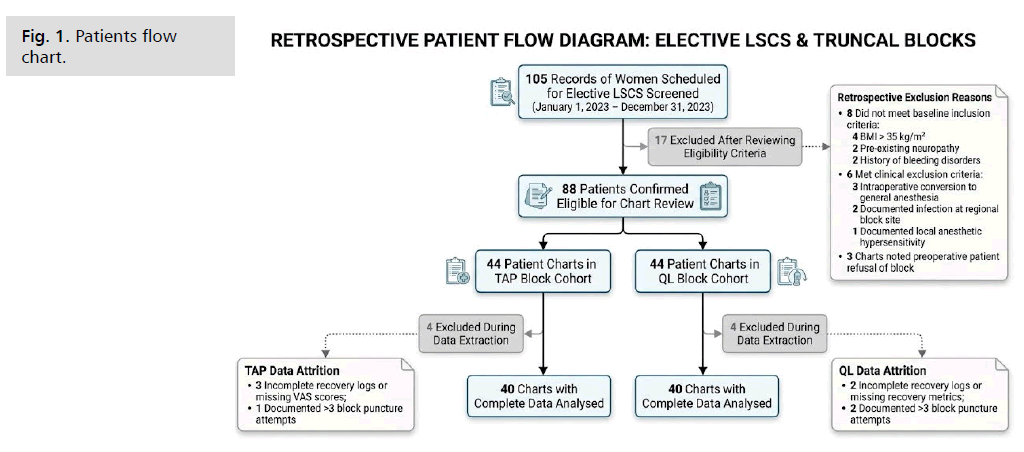
Fig. 1. Patients flow chart.
During data collection, further exclusions occurred. In the TAP cohort, 4 charts were excluded: 3 had incomplete recovery logs or missing Visual Analogue Scale (VAS) scores, and 1 had more than 3 block puncture attempts. Similarly, in the QL cohort, 4 charts were excluded: 2 had incomplete recovery logs or missing data, and 2 had more than 3 puncture attempts. Ultimately, 40 charts with complete data were analyzed in each cohort, resulting in a total of 80 patient charts for statistical analysis Based on the extracted parameters from the clinical data, here are the main results organized into structured, publication-ready tables conforming to STROBE guidelines.
Because this is an institutional retrospective cohort study assessing direct clinical outcomes, the tables present the unadjusted baseline variables, raw primary outcomes, and categorical complication profiles. Potential confounders (maternal age, BMI, ASA status, and gestational age) were evaluated and found to be statistically homogenous at baseline, eliminating the requirement for post-hoc multivariable adjustment.
Tab. 1 shows that the demographic and baseline characteristics were similarly distributed across the QL and TAP block groups. There were no notable differences in maternal age, BMI, ASA physical status, or gestational weeks. This indicates that the two groups were well matched initially, reducing the likelihood of confounding and increasing confidence that any postoperative differences are attributable to the regional block method employed.
| Variable | TAP Block Cohort (n=40) | QL Block Cohort (n=40) | t-statistic / χ2 | P-value |
|---|---|---|---|---|
| Maternal Age (years) | 28.02 ± 3.00 | 27.95 ± 3.40 | -0.10 | 0.917 |
| Body Mass Index (BMI) | 29.44 ± 2.03 | 28.90 ± 2.59 | -1.03 | 0.305 |
| ASA Physical Status | 1.77 ± 0.42 | 1.93 ± 0.27 | 1.90 | 0.062 |
| Gestation (weeks) | 38.65 ± 1.05 | 38.72 ± 0.94 | -0.31 | 0.758 |
Tab. 1: Baseline Demographics and Confounder Evaluation.
Tab. 2 shows a highly significant difference in postoperative analgesic use and block duration between the two groups. The interval until the first request for rescue analgesia was notably longer with the QL block (21.49 hours) than with the TAP block (13.01 hours). Furthermore, while total 48-hour general consumption remained stable across both groups, the QL block group required significantly lower background doses of paracetamol over the initial 24 hours. These unadjusted results suggest that the quadratus lumborum block provides superior, longer-lasting, and more targeted multimodal pain management after lower-segment cesarean sections.
| Outcome Measure | TAP Block Cohort (n=40) | QL Block Cohort (n=40) | Statistical Test Value | P-value |
|---|---|---|---|---|
| Time to First Rescue Analgesia (hours) (Primary Outcome) |
13.01 ± 1.43 | 21.49 ± 2.05 | t = 21.41 | <0.001 |
| Total 24-hr Paracetamol Dose (g) (Secondary Non-Opioid Burden) |
9.98 ± 0.82 | 4.36 ± 0.54 | t = -36.16 | <0.001 |
| Total 48-hr Tramadol Dose (mg) (Secondary Burden) |
5.69 ± 0.87 | 5.72 ± 0.70 | t = 0.16 | 0.877 |
Tab. 2: Primary and Secondary Analgesic Outcomes.
Table 3 demonstrates the longitudinal pain scores during functional movement over a 48-hour postoperative period. Consistent with the extended time to first rescue analgesia, pain scores in both cohorts gradually increased over time; however, the QL block consistently showed significantly lower dynamic VAS scores across all monitored intervals when compared directly to the TAP cohort (p < 0.001). This highly significant reduction at every time point suggests that the QL block offers a substantially more effective dynamic block against somatic and translational pain during early maternal mobilization and recovery."
| Postoperative Interval (Movement) | TAP Block Cohort (n=40) | QL Block Cohort (n=40) | Mean Difference | P-value |
|---|---|---|---|---|
| 2 Hours | 2.10 ± 0.60 | 1.10 ± 0.40 | -1.00 | <0.001 |
| 4 Hours | 2.30 ± 0.55 | 1.15 ± 0.45 | -1.15 | <0.001 |
| 6 Hours | 2.50 ± 0.65 | 1.20 ± 0.50 | -1.30 | <0.001 |
| 12 Hours | 2.95 ± 0.70 | 1.40 ± 0.55 | -1.55 | <0.001 |
| 24 Hours | 4.10 ± 0.85 | 3.20 ± 0.80 | -0.90 | <0.001 |
| 48 Hours | 3.50 ± 0.75 | 2.50 ± 0.60 | -1.00 | <0.001 |
Tab. 3: Postoperative Pain Trajectory (Dynamic VAS Scores).
Tab. 4 outlines the absolute clinical risk rates of adverse events related to the regional blocks. Incidences of postoperative nausea and vomiting were statistically indistinguishable between the groups and were easily addressed with standard medical treatments. While a minor occurrence of shivering was noted exclusively in the QL cohort, it did not reach the threshold for statistical significance (P = 0.065). The complete absence of local hematomas, injection site infections, or transient motor blockade highlights that both ultrasound-guided fascial plane blocks are highly safe and well-tolerated in obstetric patients.
| Evaluated Safety Parameter | TAP Block Cohort (n=40) | QL Block Cohort (n=40) | χ2 Value | P-value |
|---|---|---|---|---|
| Nausea (n, %) | 14 (35.0%) | 13 (32.5%) | 0.000 | 1.000 |
| Vomiting (n, %) | 7 (17.5%) | 6 (15.0%) | 0.000 | 1.000 |
| Shivering (n, %) | 0 (0.0%) | 5 (12.5%) | 3.413 | 0.065 |
| Local Hematoma (n, %) | 0 (0%) | 0 (0%) | - | - |
| Infection at Site (n, %) | 0 (0%) | 0 (0%) | - | - |
| Motor Blockade (n, %) | 0 (0%) | 0 (0%) | - | - |
Tab. 4: Secondary Outcomes – Absolute Risk of Complications.
A post hoc clinical stratification analysis was conducted to evaluate whether maternal body tissue metrics influenced outcomes. The subgroup analysis, which separated normal-weight criteria from higher-weight metrics within the eligibility limits, showed no change in the primary outcome. The trans muscular QL block consistently resulted in a prolonged time to first rescue analgesia regardless of variations in maternal subcutaneous fat layers.
Discussion
Our Results and Their Interpretation
The study population showed strong baseline homogeneity between the two treatment groups, providing a solid foundation for direct comparison of these regional analgesic techniques. Baseline maternal characteristics obtained from electronic health records—including maternal age, Body Mass Index (BMI), American Society of Anesthesiologists (ASA) physical status classification, and gestational age—revealed no statistically significant differences (P > 0.05). For instance, maternal age was highly consistent across the sample, with averages of 28.02 ± 3.00 years for the TAP group and 27.95 ± 3.40 years for the QL group (P = 0.917). This rigorous baseline uniformity minimizes major institutional confounders, suggesting that the differences observed in postoperative pain trajectories and therapeutic durability are strongly associated with the distinct anatomical coverage and fascial spread patterns of the Quadratus Lumborum block compared to the Transversus Abdominis Plane block.
In terms of functional clinical endpoints, our study’s metrics strongly favored the Quadratus Lumborum block in facilitating smoother, more comfortable dynamic recovery. Unlike static resting pain, dynamic pain scores measured during functional movement and mobilization showed highly significant reductions in the QL group compared with the TAP group across all monitored postoperative intervals (2, 4, 6, 12, 24, and 48 hours; P < 0.001). Notably, our cohort demonstrated that the QL block maintained its superiority continuously, without any transient convergence between the groups at intermediate intervals like the 12-hour mark. This significant, sustained enhancement in the control of movement-evoked pain highlights the wider, more comprehensive anatomical coverage of the QL block, which deposits local anesthetic into the thoracolumbar fascia and effectively targets both somatic and visceral pain pathways (such as those mediated by uterine contractions) via posterior and paravertebral spread.
Safety Profiles
Both regional block techniques demonstrated outstanding safety profiles, with complication rates that were both clinically and statistically indistinguishable. The incidence of common postoperative side effects, such as nausea (32.5% in QL versus 35.0% in TAP; P = 1.000) and vomiting (15.0% in QL versus 17.5% in TAP; P = 1.000), did not differ significantly. While a minor incidence of shivering was observed exclusively in the QL group (12.5% in QL versus 0.0% in TAP; P = 0.065), this trend may be attributed to the deep paravertebral spread of the local anesthetic potentially interacting with sympathetic chains involved in thermoregulation, though it did not require major pharmacological intervention. Notably, there were no major technical complications, such as local hematomas, infections at the block site, or transient motor blockade according to the Modified Bromage Scale, in either group. In conclusion, while both blocks are safe, the QL block offers a longer-lasting, more effective suppression of dynamic pain, facilitating early maternal mobilization.
Comparison of Our Results to Similar Studies
In a prospective, randomized, single-blind trial conducted [11], 40 women scheduled for elective cesarean delivery under spinal anesthesia were assigned to receive either a bilateral ultrasound-guided Quadratus Lumborum Block type 1 (QLB1) or a bilateral Transversus Abdominis Plane (TAP) block with 20 mL of 0.25% bupivacaine and 4 mg of dexamethasone on each side. Postoperative pain and opioid use were monitored over 24 hours. Consistent with our findings, their primary results showed a highly significant and prolonged increase in sensory block duration and time to first rescue request with the QL technique (23.5 ± 1.57 hours versus 15.60 ± 5.64 hours; P ≤ 0.001). Paralleling our own observed prolonged time to first rescue request and our significant reduction in secondary background analgesic burden, Agameya et al. reported a substantial decrease in cumulative 24-hour rescue opioid use. This strong correlation supports the conclusion that depositing local anesthetic into the interfascial plane of the thoracolumbar fascia provides vastly superior, longer-lasting visceral and somatic coverage compared with a standard TAP block.
In a recent comparative study [12], 48 parturients scheduled for elective cesarean section were randomly assigned to receive either a bilateral TAP block (24 patients) or a bilateral QL block (24 patients). Consistent with the specific timeframes observed in our cohort, Maharjan et al. found that the time to first rescue analgesia was significantly longer in the QL group, averaging 10.29 ± 0.75 hours, compared to 8.12 ± 1.29 hours in the TAP group (P < 0.001). While their specific postoperative pain trajectories showed no significant differences during early intermediate intervals—unlike our cohort, which demonstrated significantly lower dynamic pain scores across all postoperative intervals starting as early as 2 hours—their findings at 24 hours mirrored our long-term trajectory results. Additionally, their secondary analgesic metrics strongly support our institutional data, showing the QL group required significantly less total paracetamol over 24 hours, with an average of 2.25 ± 0.67 grams compared to 2.75 ± 0.60 grams in the TAP group (P = 0.017), directly correlating with our finding of 4.36 ± 0.54 grams in the QL group versus 9.98 ± 0.82 grams in the TAP group (P < 0.001) [13].
conducted a prospective, single-blind comparative study involving 40 patients undergoing elective cesarean sections under spinal anesthesia. The patients were randomly assigned to receive either an ultrasound-guided transmuscular QL block with 15 mL of 0.375% ropivacaine per side or a TAP block with the same volume and concentration. Their findings closely match our data regarding the overall duration of analgesia. Patel et al. found that the time to the first rescue analgesic dose was significantly longer in the QL group compared to the TAP group, averaging 12.9 hours versus 8.8 hours (P < 0.05), which closely echoes the significant extension seen in our institutional data (21.49 hours versus 13.01 hours). This consistent evidence from multiple international studies confirms that, while the TAP block remains effective for somatic pain relief in the anterior abdominal wall, the ultrasound-guided transmuscular QL block provides a more durable and reliable multimodal analgesia option after cesarean sections.
To contextualize these findings within a broader clinical landscape, our data can be compared to a systematic review and meta-analysis [14]. Pooling data from six randomized controlled trials involving 543 parturients undergoing non-emergency cesarean delivery, their analysis confirmed that 24-hour pain scores were significantly lower in the QL block group than in the TAP block group at rest and during activity, perfectly reflecting our own observed reductions in movement-evoked VAS scores over 48 hours. Ferguson et al. also reported that mothers treated with QL blocks reported higher satisfaction scores. Their results showed no difference in postoperative nausea, vomiting, or sedation, supporting our findings of low risk profiles for minor adverse events. This consistency across multiple international trials and meta-analyses confirms that while TAP blocks are reliable for anterior abdominal wall relief, ultrasound-guided transmuscular QL blocks provide more durable, dependable post-cesarean analgesia.
Clinical Implications of the study
This institutional retrospective study underscores the substantial clinical value of prioritizing the ultrasound-guided transmuscular Quadratus Lumborum (QL) block as part of multimodal analgesia following cesarean sections at King Saud University Medical City. While both the QL and TAP blocks offer comparable baseline resting pain control, identical safety metrics, and equivalent longitudinal hemodynamic stability, the transmuscular QL block provides a distinct therapeutic advantage by significantly suppressing dynamic pain during movement. This robust reduction in movement-evoked pain fundamentally enhances the immediate postoperative recovery experience, directly translating into markedly lowered 24-hour opioid burdens and significantly decreased background paracetamol consumption. Consequently, optimizing dynamic pain control with the QL block provides the clinical efficacy needed to facilitate more comfortable early maternal mobilization, thereby supporting a superior overall postpartum recovery experience.
Strengths and Limitations
A primary strength of this study is its high internal validity, achieved by evaluating standardized regional anesthesia techniques within a tightly controlled, contemporary post-cesarean multimodal protocol at a single tertiary care academic medical center. The analysis successfully integrates objective, quantifiable clinical endpoints such as precise timestamps for first rescue analgesia requests and cumulative 24-hour drug metrics with localized subjective markers, including resting and dynamic Visual Analogue Scale (VAS) trajectories.
Several limitations must be acknowledged. The study's retrospective, single-center cohort design restricts the generalizability of the findings to different institutional protocols or varied patient demographics. Furthermore, while our baseline parameters were homogenous, retrospective data extraction limits our ability to definitively control for minor intraoperative variations other than the standardized spinal anesthesia dosing. Although the sample size of 80 was statistically powered post-hoc to validate the primary outcome, it remains relatively modest. The data extraction was confined to the first 24 hours post-surgery, preventing assessment of late-onset block degradation, delayed complications, or long-term chronic postsurgical pain development. Additionally, monitoring background rescue paracetamol and intermittent tramadol dosing may offer less precision in detecting subtle breakthrough pain fluctuations compared to continuous, intravenous patient-controlled analgesia data.
Recommendations for Further Studies
To expand upon these institutional findings, future research should prioritize large-scale, multi-center, prospective randomized controlled trials to eliminate the inherent selection and charting biases associated with retrospective reviews. Longitudinal monitoring protocols should be extended to 48 or 72 hours postoperatively to definitively map the exact offset kinetics of the QL block and evaluate its potential role in preventing persistent post-cesarean pain syndrome. Additionally, integrating standardized intravenous opioid patient-controlled analgesia (PCA) devices in future study designs will provide a highly sensitive, continuous objective metric for quantifying breakthrough pain and absolute opioid-sparing margins. Finally, comparative trials are warranted to investigate the dose-response curves of different local anesthetic volumes and distinct technical approaches such as directly comparing Transmuscular Anterior (QL3) vs. Posterior (QL2) injections to establish the absolute gold-standard regimen for obstetric multimodal recovery.
Conclusion
In conclusion, while both ultrasound-guided bilateral Transversus Abdominis Plane (TAP) and transmuscular Quadratus Lumborum (QL) blocks offer excellent safety profiles, stable perioperative hemodynamics, and effective baseline resting analgesia, they are not clinically interchangeable. The Quadratus Lumborum block provides a significantly longer duration of effective postoperative analgesia, delays the time to first rescue intervention, and reduces the cumulative 24-hour opioid and non-opioid consumption. Most importantly, the QL block provides superior mitigation of dynamic pain during movement and early mobilization, establishing it as a highly effective, opioid-sparing regional technique for optimizing maternal recovery after lower segment cesarean sections.
Funding
This research received no external funding.
Declaration of Interest
The authors declare that they have no competing financial interests or personal relationships that could have appeared to influence the work reported in this paper.
Ethics Approval
Ethical approval for this retrospective cohort study was obtained from the Institutional Review Board (IRB) committee of King Saud University Medical City (KSUMC), Riyadh, Saudi Arabia. The study was conducted in strict accordance with the ethical standards of the Declaration of Helsinki and local institutional regulations.
Consent to Participate and Publish
Written informed consent for the clinical performance of the regional blocks had been routinely obtained from all individual patients prior to surgery. Due to the retrospective nature of this medical chart review, the requirement for study-specific informed consent was formally waived by the KSUMC IRB committee. Patient confidentiality was strictly maintained, and all collected clinical data were fully de-identified prior to analysis and subsequent publication.
Data Availability Statement
The datasets generated and analyzed during the current study are available from the corresponding author upon reasonable request.
Declaration of Generative AI in Scientific Writing
During the preparation of this manuscript, the authors utilized Google Gemini to assist with linguistic refinement, structural formatting, and data presentation. This tool was used strictly to enhance readability, clarity, and grammatical syntax. The human authors thoroughly reviewed, verified, and edited all outputs, retaining full and final responsibility for the scientific accuracy, clinical integrity, and content of the submitted work.
Acknowledgments
Not applicable.
Author Contributions
The final version of the manuscript has been thoroughly read, reviewed, and approved by all listed authors. Individual author contributions are designated as follows:
• ISM (Ibrahim Shazly Mohamed): Conceptualization, primary methodology design, clinical data extraction, and critical review of the initial manuscript draft. ARMS (Amr Raafat Mahmoud Seif): Formal statistical data analysis, visualization, original draft preparation, critical manuscript revision, structural editing, final manuscript formatting, and journal submission/correspondence management.
• JB (Jumana Baaj): Clinical regional anesthesia block performance, study supervision, protocol consistency verification, and critical revision of the methodology.
• AAE (Ahmed Alizein Elnizamy): Main project coordination, data curation, manuscript structural review, clinical interpretation, and editing of the final draft.
References
- Macias DA, Adhikari EH, Eddins M, Nelson DB, McIntire DD, et al. A comparison of acute pain management strategies after cesarean delivery. Am J Obstet Gynecol 2022 ;226 :407-e1.
- Duran S, Vural G. Problems experienced by the mothers in post-cesarean period: A narrative review. Iran J Public Health. 2023; 52: [2036-2041].
- Siwicki A, Adams RM, Cabasa K, Madan S, Ouillette H. Postpartum pain management for women undergoing cesarean sections using a multimodal pain control protocol: A retrospective study. BMC Pregnancy and Childbirth. 2025; 25: [1318].
- Kincaid S, How J, Agrawal DK. Multimodal Analgesia in the Perioperative Period of Major Surgeries: An In-depth Analysis. Anaesth Crit Care. 2025; 73: [68-76].
- Hussain N, Brull R, Thaete L, Fuller S, D'Souza RS ,et al. The analgesic effects of novel fascial plane blocks compared with intrathecal morphine after Caesarean delivery: A systematic review and meta-analysis. Br J Anaesth. 2025; 134: [1415-1431].
- Elashry HE, Abdelbadie M, Elshabacy AA, Elmiseery OA. Analgesic effect of quadratus lumborum block type III and type II versus lateral transversus abdominis plane block in cesarean section: A randomized controlled multicenter trial. Anesth Pain Med; [141:e140464].
- Mallan D, Sharan S, Saxena S, Singh TK, Faisal et al. Anesthetic techniques: Focus on Transversus Abdominis Plane (TAP) blocks. Local and regional anesthesia. 2019:[81-88].
- Akerman M, Pejcic N, Velickovic I. A review of the quadratus lumborum block and ERAS. Front Med 2018: [5-44].
- Jadon A, Amir M, Sinha N, Chakraborty S, Ahmad A, et al. Quadratus lumborum or transversus abdominis plane block for postoperative analgesia after cesarean: A double-blinded randomized trial. Braz J Anesthesiol 2022;72:[472-478].
- Ferguson JE, Tubog TD, Johnson W, Evans H, Furstein J. Quadratus lumborum block and transversus abdominis plane block in non-emergency cesarean delivery: A systematic review and meta-analysis. J Perianesth Nurs 2024: [226-34].
- Agameya HM, ElNakeeb MM, Elboughdadly AM, Maaly AM. Bilateral ultrasound-guided quadratus lumborum block versus bilateral transversus abdominis plane block for postoperative analgesia after cesarean section. Res Opin Anesth Intensive Care. 2024;11: [38-44].
- Maharjan M, Dhital A, Bajracharya P, Shrestha S, Hyoju SP, et al. Comparative study of postoperative analgesia with Transversus Abdominal Plane block and Quadratus Lumborum Block after cesarean section. Nepal Med J. 2025;8:[94-8].
- Patel Nimesh H, Prajapati Sonali P, Shah Rajkiran B, Parikh Beena K, Parikh Geeta P. Comparative Study of Quadrutus Lumborum Block Vs. Tranversus Abdominis Plane Block for Postoperative Analgesia After Caesarean Section. Int J Med Pharm Res. 2026; 7: [519-527].
- Ferguson JE, Tubog TD, Johnson W, Evans H, Furstein J. Quadratus lumborum block and transversus abdominis plane block in non-emergency cesarean delivery: A systematic review and meta-analysis. J Perianesth Nurs. 2024; 39: [226-234].
Google Scholar, Cross Ref , Indexed at
Google Scholar Cross Ref , Indexed at
Google Scholar Cross Ref , Indexed at
Google Scholar Cross Ref , Indexed at
Google Scholar Cross Ref , Indexed at
Google Scholar Cross Ref , Indexed at
Google Scholar, Cross Ref , Indexed at
Google Scholar, Cross Ref , Indexed at
Google Scholar, Cross Ref , Indexed at
Google Scholar, Cross Ref , Indexed at
Google Scholar, Cross Ref , Indexed at
Google Scholar, Cross Ref , Indexed at
Google Scholar, Cross Ref , Indexed at
Author Info
Ibrahim Shazly Mohamed, Amr Raafat Mahmoud Seif*, Amr Raafat Mahmoud Seif, Jumana Baaj and Ahmed Alizein ElnizamyCopyright:This is an open access article distributed under the terms of the Creative Commons Attribution License, which permits unrestricted use, distribution, and reproduction in any medium, provided the original work is properly cited.